
Sea Turtles, Stingrays & Sharks: Your Punta Cana Marine Life Guide
What lives in the reefs and waters around Punta Cana — sea turtles, stingrays, three shark species, parrotfish, moray eels, and more. Where to see them, how to interact respectfully, and which excursions give you the best chance of encounters.
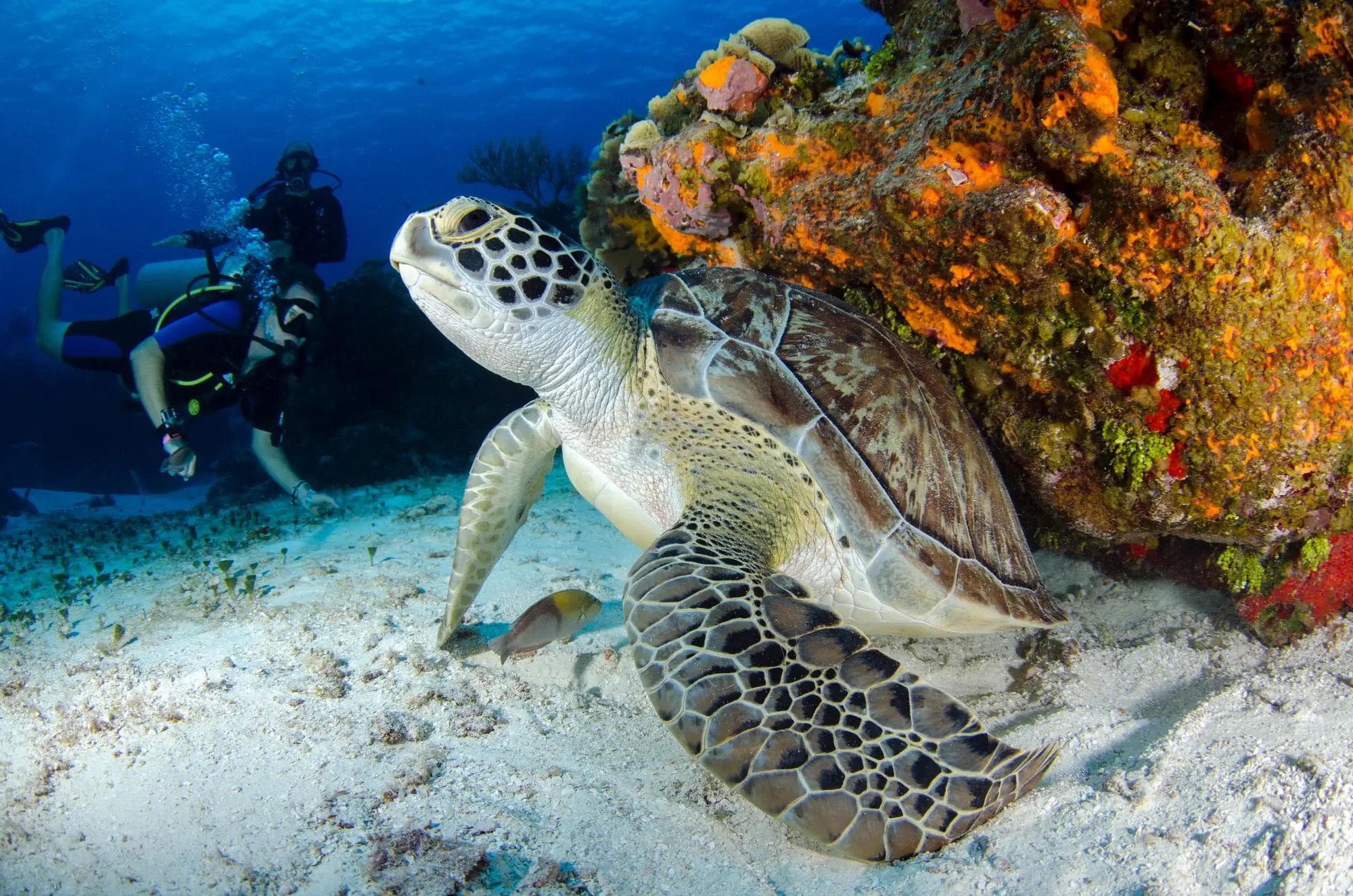
The Caribbean waters off Punta Cana are home to one of the most accessible marine ecosystems in the world. You don't need to be a certified diver to encounter the species described in this guide — most of them appear regularly during snorkeling trips, beach excursions, and shallow reef explorations. Sea turtles graze on seagrass in waist-deep water near Saona Island, stingrays cruise the sandy bottoms between coral heads, and three different species of sharks live here without posing any meaningful danger to swimmers.
This guide walks through the headline animals you're likely to see, where to find them, what their behavior actually looks like, and how to interact responsibly. Everything here comes from years of guiding people on the reefs through both snorkeling excursions and the dedicated dive programs run by our parent company Grand Bay of the Sea.
Green Sea Turtles and Hawksbill Turtles
Two species of sea turtle live on the Punta Cana reefs year-round: the green sea turtle (Chelonia mydas) and the hawksbill turtle (Eretmochelys imbricata). Greens are larger, with adults weighing up to 200 kg and reaching shell lengths of over a meter. They're primarily herbivorous, grazing on seagrass beds in shallow water — which is why they're often the easiest species for snorkelers to spot near Saona Island and the Cabeza de Toro reefs.
Hawksbills are smaller and more colorful, with a beautifully patterned shell that historically made them targets for the tortoiseshell trade. They eat sponges and small invertebrates from the reef structure itself, and you're more likely to see them on dive trips than from the surface. Both species are listed as endangered, and Dominican law prohibits touching, feeding, or otherwise interfering with them.
Where and How to See Them
The Saona Island Natural Pool sandbar is one of the most reliable places to encounter green sea turtles in the wild. They come up to graze on the shallow seagrass, sometimes within just a few meters of swimmers. The reefs around Cabeza de Toro and Bávaro also host resident turtle populations. Best time of day is early morning or late afternoon when feeding activity peaks. Behavior is calm and unhurried — they ignore swimmers almost entirely if you stay calm and don't approach directly.
How to Interact Respectfully
Stay at least 3 meters away. Don't touch, don't chase, don't try to ride. Avoid bright camera flashes. If a turtle approaches you out of its own curiosity, stay still and let it choose how close to come. Avoid blocking its path to the surface — turtles must breathe air and become stressed if they can't get up.
Southern Stingrays and Spotted Eagle Rays
Two ray species dominate the reefs here. The southern stingray (Hypanus americanus) is the species you're most likely to see — flat, gray-brown, often half-buried in sand. Wingspan reaches about 1.5 meters in mature animals. They're docile, but they do have a stinger on the tail that can cause painful injury if stepped on. The famous safety advice is the "stingray shuffle" — when walking in shallow sandy water, shuffle your feet rather than stepping down, and any nearby ray will move away rather than being startled into stinging.
Spotted eagle rays (Aetobatus narinari) are larger, more dramatic, and far more rarely encountered. They have a distinctive spotted pattern, wingspan up to 2 meters, and a habit of cruising in graceful slow loops above coral heads. They're free-swimmers rather than bottom-dwellers, and seeing one on a dive or snorkel trip is the kind of encounter that becomes a story you tell.
Where and When to Spot Them
Sandy patches between coral heads at depths of 5 to 15 meters are stingray territory. The boat anchorages used by our catamaran excursions often have resident stingrays that have become accustomed to swimmers. Eagle rays favor deeper water and are most often seen on certified dive trips at sites like the Catalina wall.
Safety Notes
Stingrays sting only defensively. They don't pursue or attack swimmers. The injury risk is almost entirely from stepping on a buried ray in shallow water — which is preventable by shuffling. If a sting does occur, soak the wound in hot water (not so hot it burns) and seek medical attention. It's painful but rarely dangerous, and we have not had a serious incident in years of operation.
Nurse Sharks
The nurse shark (Ginglymostoma cirratum) is the most common shark species on the Punta Cana reefs and the gentlest of all reef sharks. Adults reach 2 to 3 meters in length, with a heavy brown body, small eyes, and distinctive whisker-like barbels near the mouth. They spend most of the day resting motionless under coral ledges or in sandy alcoves, becoming more active at night when they hunt small fish, crustaceans, and rays.
Encounters during snorkeling and diving are entirely calm. Nurse sharks ignore divers and continue resting even when photographers approach to within a meter. They have small mouths and bottom-feeding behavior, and there has never been a recorded fatal attack by a nurse shark on a human anywhere in the world. The few injuries on record have all involved humans grabbing the shark first.
Where to See Them
Nurse sharks are reliably present at several of our regular dive sites, particularly the reef ledges off Cabeza de Toro. Daytime sightings during dives are common; nighttime is when they're most active but most divers visit during the day. They rest in the same locations day after day, so guides know exactly where to find them.
Blacktip Reef Sharks
The blacktip reef shark (Carcharhinus melanopterus) is a sleek, classic-looking reef shark with distinctive black-tipped fins. They reach about 1.8 meters in length and move much more actively than nurse sharks, cruising the reef in elegant patrolling patterns. They're predators of small reef fish but show no interest in humans under normal circumstances.
If you want a structured shark encounter, the dedicated Shark Diving Punta Cana experience from our parent company is designed specifically for certified divers comfortable with controlled close encounters. The shark dive uses a feeding setup that attracts multiple blacktips to a specific site, with experienced safety divers managing the interaction. It's controlled, regulated, and one of the more dramatic things you can do in the Dominican water.
Are Blacktip Reef Sharks Dangerous?
Statistically, no. There have been a small number of recorded incidents worldwide, mostly involving spearfishing or unusual situations. In a structured shark dive setting with professional safety divers, the risk profile is dramatically lower than for many activities tourists do without thinking — like driving rental cars on unfamiliar roads. The sharks are wary of humans and tend to keep distance even during feeding events.
Reef Fish: The Background Cast That Steals the Show
While turtles, rays, and sharks get top billing, the reef fish are what fills your visual field on any snorkel or dive. The Caribbean has hundreds of species in this category, and Punta Cana's reefs host most of them. A few you'll definitely encounter:
Parrotfish
Stoplight parrotfish, queen parrotfish, and rainbow parrotfish are all common. They're large (up to 60 cm), brilliantly colored, and play a critical ecological role — their constant grazing on algae prevents reefs from being overgrown. A single parrotfish produces hundreds of pounds of fine white sand per year by digesting coral. The white beaches of Punta Cana are partly parrotfish excrement, which is a fact most travelers find more entertaining than off-putting.
Angelfish
French angelfish, queen angelfish, and gray angelfish are all reef residents. They're often paired and stay together for years, which makes encounters charming — you'll usually see them gliding side by side along the reef face.
Sergeant Majors, Wrasses, and Damselfish
These smaller species form the dense schools that surround you when snorkeling near a busy reef. They're harmless, curious, and provide much of the visual texture of a reef dive.
Grunts and Snappers
Yellowtail snappers travel in dense silvery schools that occasionally part around swimmers like a curtain. Schoolmaster snappers and various grunts hover under coral ledges in tight clusters. These are the fish most likely to come close to a calm snorkeler.
Moray Eels
The green moray eel (Gymnothorax funebris) and the spotted moray (Gymnothorax moringa) live in virtually every coral crevice on Punta Cana's reefs. Their open-mouthed posture looks aggressive but is actually how they breathe — pumping water across their gills. They're territorial within their crevice but show no interest in pursuing divers or snorkelers. They emerge at night to hunt fish and crustaceans, but daytime sightings of their heads protruding from coral are very common.
What to know: never put your hand into a coral crevice. Most moray injuries happen when someone reaches into a hole without looking. As long as you respect the moray's space, you can observe at close range without any risk.
Octopuses, Squid, and Cuttlefish
The Caribbean has resident octopus species that are reasonably common but require patience and a good guide to spot. The Caribbean reef octopus (Octopus briareus) is the local resident — a smaller species (up to 60 cm including tentacles) that lives in coral crevices and changes color rapidly when disturbed. They're most active at dawn and dusk. Daytime encounters happen but require luck.
Reef squid (Sepioteuthis sepioidea) sometimes appear in small schools above shallow coral. They're elegant, hover in formation, and have iridescent skin that flashes between colors. Cuttlefish are rare visitors but possible.
Conservation: Why It All Still Exists
Punta Cana's reefs are in better condition than many comparable Caribbean ecosystems, but they're under pressure. Coral bleaching events from rising sea temperatures, sargassum influxes from changing Atlantic currents, and direct damage from boat anchors and careless tourism all add up. Several actions matter for keeping the marine life you've come to see:
- Use reef-safe sunscreen (no oxybenzone or octinoxate). Standard sunscreens contain chemicals that damage coral at concentrations as low as a few parts per million.
- Never touch coral. Even gentle contact kills the polyps that took decades to grow.
- Maintain good buoyancy on dives. Coral damage from fins is one of the leading causes of reef damage in tourist diving areas.
- Don't feed fish. It alters behavior, attracts the wrong species, and can make fish aggressive toward subsequent divers.
- Carry out everything you bring. Plastic bottles, sunscreen tubes, and bag clips that fall in the water cause real harm.
- Choose operators that follow these practices. Our snorkeling and diving programs are run with conservation as a core operating principle.
When You're Most Likely to See What
Different species are more reliably encountered at different times. A rough guide:
- Sea turtles — year-round, but most active in early morning and late afternoon.
- Stingrays — year-round, found in sandy areas at all depths.
- Nurse sharks — year-round, daytime sightings under ledges, more active at night.
- Blacktip reef sharks — year-round on dedicated shark dives, occasional during regular dives.
- Reef fish — universally year-round, highest activity at dawn and dusk.
- Eagle rays — most common in April through October.
- Octopus — possible year-round, easiest to find at dawn or dusk.
- Humpback whales — January through March, in Samaná Bay (a 3-hour drive from Punta Cana).
Common Misconceptions About Caribbean Sharks
Movies and headlines have done sharks a real disservice. A few corrections that come up almost every time we lead first-time guests on a reef dive:
"Sharks attack swimmers." Statistically, you have a higher chance of being killed by a falling coconut than being seriously injured by a Caribbean reef shark. The species that live on Punta Cana's reefs — nurse, blacktip, and occasionally Caribbean reef sharks — are not the species involved in the rare attacks that make news. Those are typically bull sharks, tiger sharks, or great whites in very different environments. The animals you'll encounter here ignore swimmers as a matter of routine behavior.
"Sharks are attracted by blood from small cuts." This persistent myth comes from movies. Sharks can detect very dilute concentrations of fish blood at long distances, but they're not particularly interested in human blood, and a small cut from a coral scrape doesn't put you at risk. Period menstruation doesn't increase shark risk either — the National Park Service and multiple marine biology institutions have confirmed this repeatedly.
"Diving with sharks is reckless." Structured shark dives in the Caribbean have an excellent safety record over decades of commercial operation. The protocols developed by the dive industry — controlled feeding, multiple safety divers, distance management — make these encounters dramatically safer than many activities considered routine. Driving to the dive site is statistically more dangerous than the dive itself.
Photographing Marine Life
Underwater photography has become much more accessible thanks to smartphone housings and inexpensive action cameras. A few practical points if you want to come home with images that capture what you saw:
- Get close. Water absorbs and scatters light, which means anything more than 2 meters away will look hazy and blue regardless of how clear the water seems. The best wildlife photos come from being within touching distance — without actually touching.
- Shoot upward when possible. Looking up at a turtle silhouetted against the surface produces dramatic images. Looking down at a turtle on sand produces flat ones.
- Disable flash for fish. Flash photography stresses many reef species and produces poor results because of backscatter from particles in the water. Natural light works better.
- Stabilize before shooting. Underwater motion blur is the main reason photos look bad. Get neutral, take a slow breath, then shoot.
- Accept that some moments belong to memory. Trying to film an encounter often costs you the encounter itself. Sometimes the right choice is to put the camera away and just watch.
If you're doing the Discover Scuba course, the dive guide can usually help with shots if you let them know you want some.
Excursions That Let You See These Animals
Different excursions give different windows into the marine ecosystem. The shortest path to seeing turtles is the Saona Island day trip, where the Natural Pool sandbar has resident green turtles. For broader reef life, a snorkeling catamaran cruise visits multiple reef sites in a day. For the deepest engagement, scuba diving — even at the introductory Discover Scuba level — puts you face to face with everything in this guide.
Specialty trips like the Catalina Island day excursion combine diving and snorkeling at one of the richest reef systems in the country, suitable for both certified divers and non-divers on the same trip. And for travelers who want the closer-up shark encounter, the dedicated shark dive is a separate booking from a single operator with specialized safety protocols.
Final Thoughts
The marine life of Punta Cana is the single most rewarding part of visiting the Dominican Republic that travelers underestimate before they arrive. A first encounter with a green sea turtle in waist-deep water shifts how you think about a vacation; a slow dive past a resting nurse shark stays in your memory longer than most beach days. The animals are real, present, and accessible — but their continued presence depends on visitors approaching them with care.
If you'd like to plan a trip around the marine life you most want to see, contact our team with your dates and interests. We'll suggest the specific excursions that match what you're hoping to encounter, and we'll be honest about which sightings are reliable and which take some luck. A few last thoughts worth holding onto: the reef rewards patience more than equipment, the best wildlife encounters usually happen when you stop trying to make them happen, and the snorkelers and divers who come back year after year are the ones who've learned to slow down. The Caribbean below the surface is not a checklist of species to tick off; it's a living place to revisit, and the more time you spend in it, the more it shows you.